
"Ok, we're done!"
Now let's talk $40k

What Happened
Bitcoin spent the first day of July doing the thing everyone was dreading, then spent the next three doing the thing almost nobody was positioned for. It fell to $57,735 on July 1, the lowest it’s traded in 652 days, capping a June that took roughly a fifth off the price. Then it turned. By July 3 it was back above $62,000, and the reversal cost the bears real money — about $281 million in short positions got liquidated, nearly double the longs. Ethereum led the way up, jumping 11 to 13% on the week to around $1,780. Solana ran 15% or more back above $80, and XRP reclaimed $1.10.
The thing that broke the fall came from the labor market, not from crypto.
The June jobs report landed Thursday and it was ugly: just 57,000 jobs added against expectations near 115,000, the weakest in four months, with April and May revised down by a combined 74,000. Unemployment actually ticked down to 4.2%, but for the wrong reason — the participation rate fell to 61.5%, the lowest since March 2021, and the household survey showed half a million fewer people working. Markets took one look and decided the Fed can’t hike into a labor market that’s cooling this fast. The 2-year yield dropped to 4.13%, and Warsh followed up by saying inflation risks had eased — his first dovish word since the June meeting that started this whole mess.
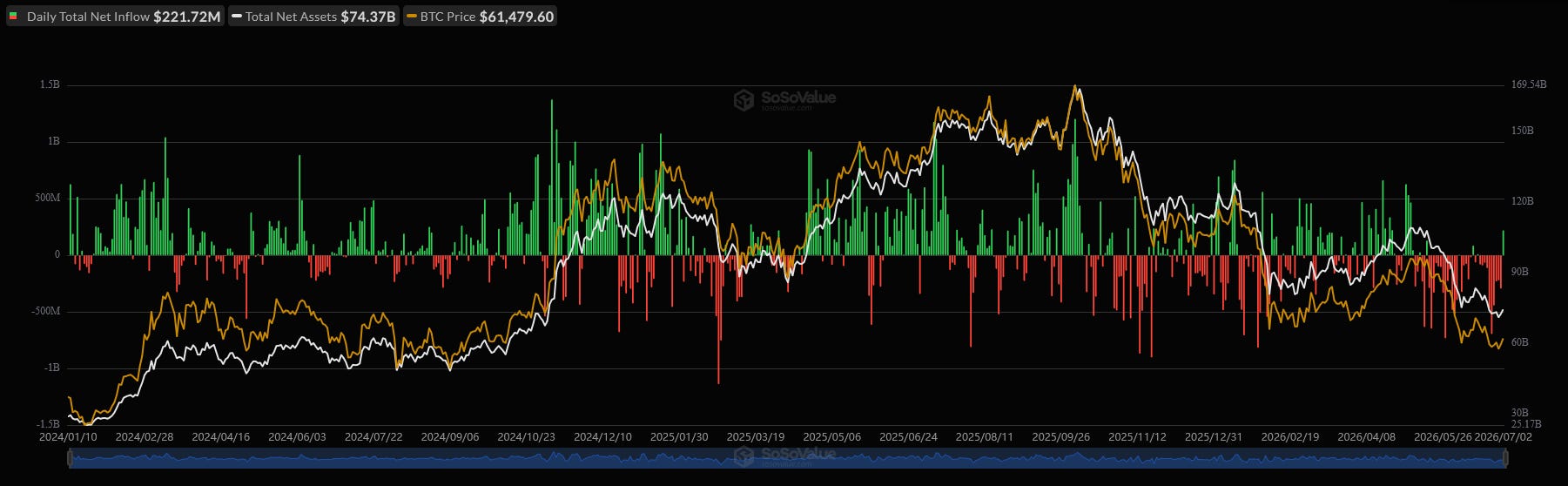
Underneath the price, the ETF story finally cracked in the other direction. June was the worst month in the history of the spot Bitcoin funds, with about $4.06 billion pulled out, which dragged 2026’s cumulative flows negative for the first time ever. BlackRock’s IBIT did most of the bleeding, roughly $3.55 billion on its own. Then on July 2 the funds took in about $222 million, the biggest single inflow day in a month, snapping a 10-day outflow streak, and by July 3 they’d strung together five straight days of buying. BlackRock’s new staked-Ethereum fund pulled in $100 million on its first day.
Europe’s crypto map got redrawn on July 1, when MiCA’s transition period officially ended and enforcement went live across all 27 states. Only around 244 firms out of more than 3,000 secured a license. The headline casualty was Binance, which suspended services for EU residents after pulling its license application in Greece on June 24 — reportedly one step ahead of a rejection tied to co-founder Changpeng Zhao and the exchange’s anti-money-laundering history. It’s now trying France, though on July 3 the Wall Street Journal reported that ESMA had privately advised regulators to turn Binance down. More than 10 million EU users now have to move to a licensed platform, and Tether’s USDT got pushed off regulated European exchanges entirely.
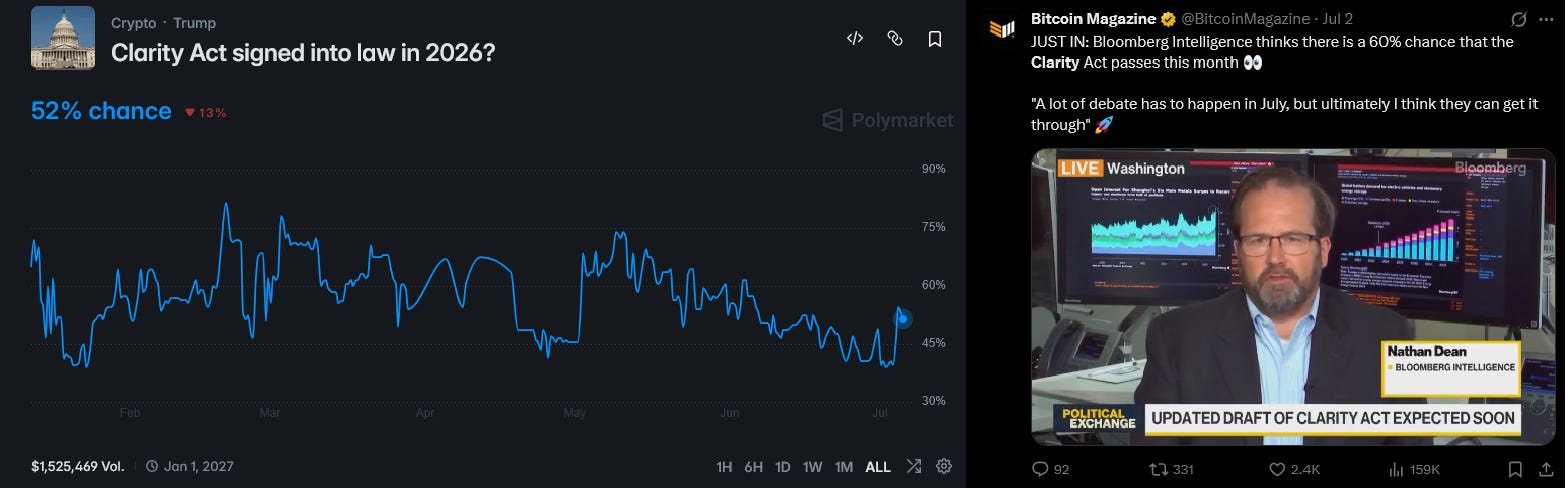
On the policy front, the CLARITY Act blew past the Fourth of July finish line the White House had wanted. New text was expected over the holiday weekend, the Senate returns July 13, and there’s a roughly two-week window to get it to a vote before the August recess — after which it likely slips out of this session entirely. The odds are genuinely contested: Polymarket has 2026 passage near 50%, while Bloomberg Intelligence puts it at 60% this month. Trump spent an interview on CNBC calling crypto “a big deal” and warning that if the U.S. doesn’t lead, China will — while fielding questions about the roughly $1.4 billion his family made in crypto last year.
And a few things happened inside crypto that had nothing to do with the Fed.
Strategy paused its Bitcoin buying, holding at 847,363 BTC while rebuilding a $2.55 billion cash reserve.
Metaplanet added 2,823 BTC to reach 43,000 and became the third-largest corporate holder.
A new nonprofit called Ethereum Institutional launched, backed by BitMine, SharpLink, and Joseph Lubin, aimed at getting banks and asset managers onto Ethereum.
Tokenized real-world assets on Solana crossed $8.5 billion, up about 120%.
Where Are We
Here’s a fact that should bother you more than the price. If you polled a hundred people who’ve never owned Bitcoin, all hundred would tell you they’re not interested. Poll the people who actually held it through this market, and something like two-thirds are questioning why they bothered.
That’s not a scared market. Scared was earlier this year. This is a tired market — the kind of tired where the die-hards are still here and everyone else has mentally moved their money into AI stocks and whatever IPO’d last week. The clearest tell isn’t the chart. It’s that half your timeline has spent the week turning Michael Saylor into a piñata. People don’t do that at tops. They do it when they’re angry, and they get angry when they’re underwater, and being underwater is what the bottom of a bear market feels like from the inside.

So let’s do the thing most of these newsletters won’t, and take the bear case seriously instead of waving at it.
The most honest voice in the room right now belongs to the people saying capitulation hasn’t actually happened. Gary Cardone has been blunt about it: at $62,000 people are throwing parties like it’s $100,000, when the plain arithmetic is that we’ve lost nearly $40,000 off the top and decided that’s the turn. His argument isn’t a vibe, it’s structural, and it deserves to be heard properly.
Somewhere around 150 to 180 corporate treasury copycats piled in behind Strategy and bought roughly 350,000 Bitcoin, most of them with no yield, no plan, and, in his words, no clue — and if those crack, they don’t sell gently.
Miners are already capitulating at a record clip, dumping about 32,000 coins in the first quarter alone, which is more than they sold during the entire Terra collapse in 2022.
The old guard is exhausted; the OGs who carried this thing for fifteen years are openly saying they’ve got nothing left, their heads are in SpaceX and their retirement, and the new buyer who’s supposed to replace them hasn’t shown up at size.
Galaxy’s own June report pegs a base-case low around $40,000 to $46,000 and points out this drawdown is only 51% versus the 77 to 85% we’ve printed before. That is a real case made by serious people, and anyone who tells you $50,000 is impossible from here is selling you something.
Now the other half of the room, and it’s just as real. Look at who’s actually buying while everyone else quits. The addresses that only ever accumulate and hold are ramping at a pace we rarely see. The wallets holding one to ten thousand coins have gone near-vertical since the drop from $80,000, and the same on-chain desks that reliably sell into every local top have been buying this entire bear market — roughly 270,000 coins absorbed near the lows, most of it not coming from U.S. buyers. And the way they’re getting filled tells its own story.
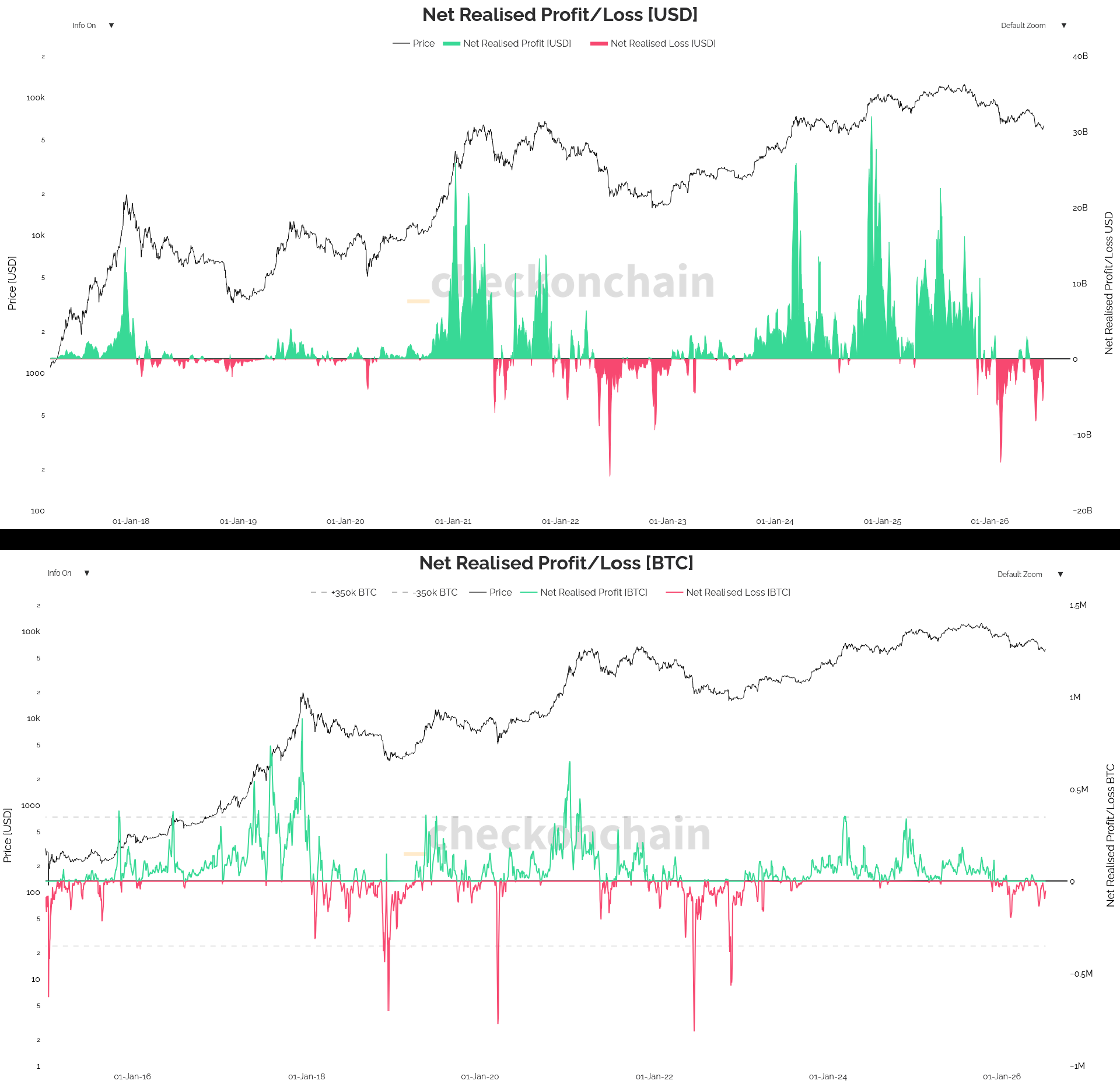
Each leg down this year — the flush to $60,000, then $63,000, then $57,000 — produced smaller and smaller realized losses, which is the technical way of saying fewer people are willing to sell at a loss anymore. That’s not what a market looks like right before it falls apart. It’s what one looks like when the weak hands are already gone.
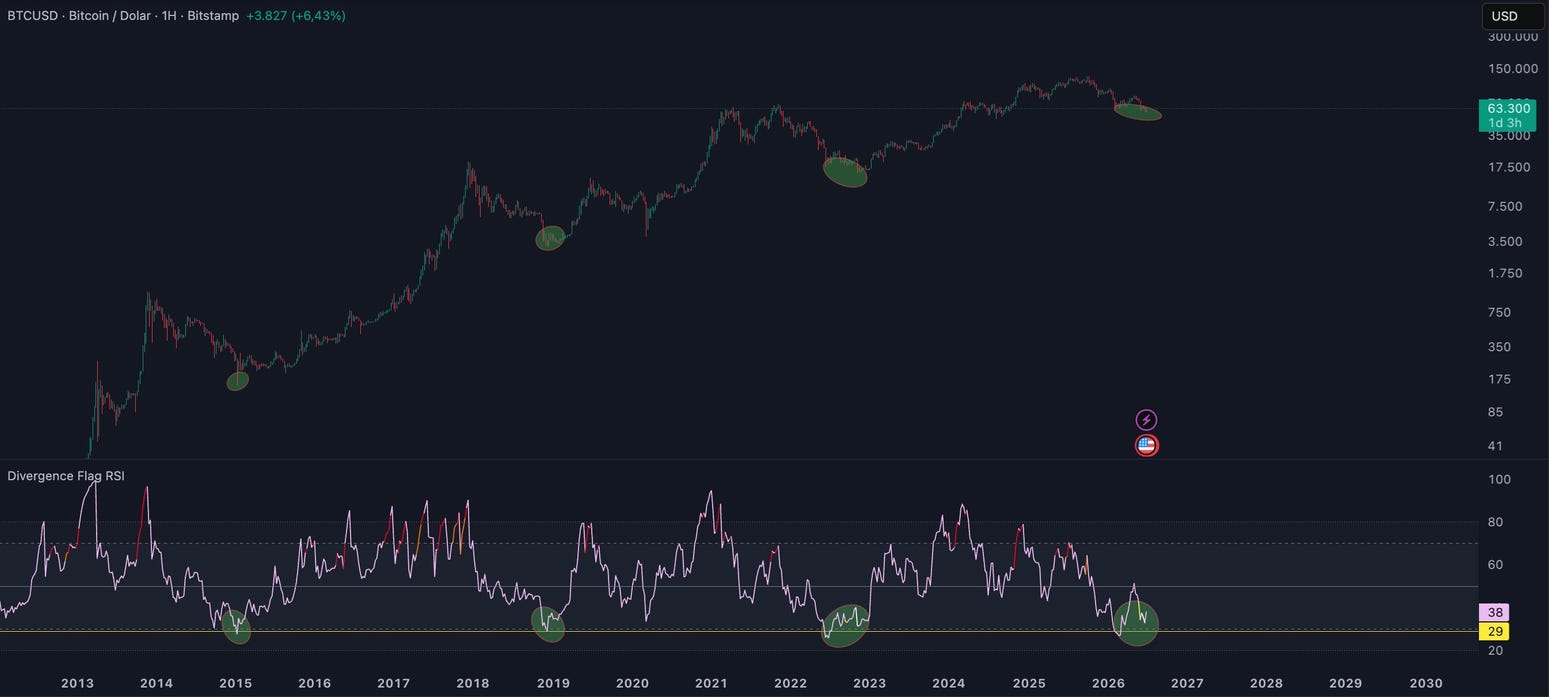
The chart backs it up in a way that’s hard to dismiss. Bitcoin’s monthly RSI is sitting right on the trendline that has marked the bottom of every single bear market, with the same bullish divergence underneath it that showed up in 2015, 2019, and 2022. The daily reading hit 29 this week, the deep-oversold zone that has lined up with every prior generational low. On the power-law model that’s tracked this asset for over a decade, the line sits near $53,600 — meaning if you’re waiting for $40,000, you’re not waiting for a discount, you’re waiting for Bitcoin to trade below where COVID left it in real terms.
Could it happen? Sure.
A final minus-60% flush would fit the pattern, and this cycle has already delivered the kind of capitulation that took an FTX-sized disaster to produce last time — except this time there was no FTX. The worst catalyst we got was a war and Saylor selling some coins. That’s it.
Then there’s the part that has nothing to do with candles, and it’s the piece I keep coming back to. The two forces that drove this crash are both reversing. The inflation scare that had everyone convinced the Fed would hike — the thing that actually caused Bitcoin’s last leg down — was built on energy prices, and energy has collapsed. We’re likely looking at a negative CPI print for June.
The “debasement trade” that lumped Bitcoin in with gold and silver on the way down works the same way on the way up. And the AI trade, the black hole that’s been swallowing every spare dollar of risk appetite for a year, is showing the first cracks of a midcycle slowdown. When Micron posts blowout numbers and the stock is lower two weeks later, that’s not strength, that’s a top — you sell the good news when the easy money is already gone. The moment that capital stops finding ten-baggers in semiconductors and starts looking for the next thing, the most beaten-down, lowest-volatility risk asset on the board is sitting right there.
And here’s the deeper irony worth sitting with. Governments are climbing further into the AI story by the week;
OpenAI reportedly floating a 5% stake to the White House,
models getting shut down,
Meta suddenly pivoting to become a compute company,
Chinese open-source eating into the American lead.
That’s the exact condition Bitcoin was built to answer: what do you own when the state gets its hands too far into the capital markets and the money printer? The reason to hold this thing, the original one, is getting louder at precisely the moment everyone’s stopped listening.
If and when risk appetite does come back, the smart read is that Ethereum leads, not Bitcoin. Forget the price for a second and look at the scoreboard, as one former BlackRock executive put it this week:
Ethereum settles more than half of all stablecoin activity,
hosts over 55% of tokenization,
and owns the serious end of DeFi.
The fundamentals already won. What’s missing is the narrative — it’s inertia and storytelling, and storytelling is the easiest gap in markets to close. ETH leading this week’s bounce by double digits isn’t just noise.
So where does that leave us, honestly?
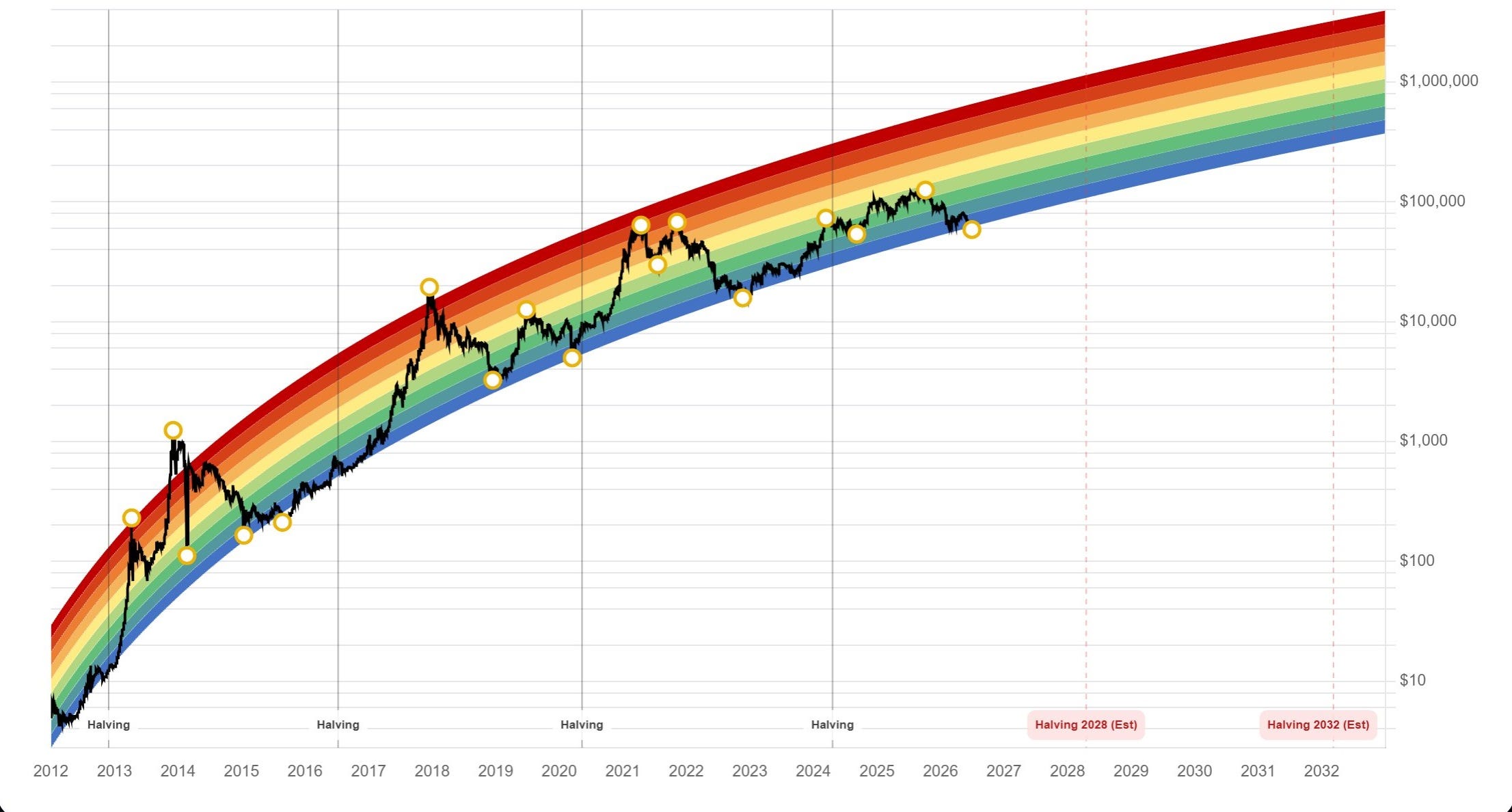
Both sides are right, and they’re right about different questions. Cardone is right that capitulation in the textbook sense — the OG exhaustion, the copycat-treasury overhang, the miner bleed, the missing new buyer — hasn’t fully played out, and $40,000 to $50,000 is a live risk that no amount of bullish on-chain data erases. And the bottoming crowd is right that the exact cluster of signals that has marked every prior floor is flashing all at once. The mistake is treating that as a contradiction to be solved. It isn’t. It’s a time-horizon question wearing a price-target costume.
If you need this money in the next four months, you’re not an investor in a volatile asset, you’re a credit investor, and a thin bounce built on a short squeeze and holiday liquidity should scare you — because the $57,000 level cracking with the treasury and miner overhang behind it gets you Cardone’s number fast.
But if you’re accumulating on a multi-year view;
then you’re being handed a 53% drawdown,
an RSI at generational-low levels,
whales loading the boat,
and a macro backdrop that’s flipping under the surface — which is the exact setup you swore you wanted back when this thing was $126,000 and you were mad you missed it.
We’re not going to call the bottom.
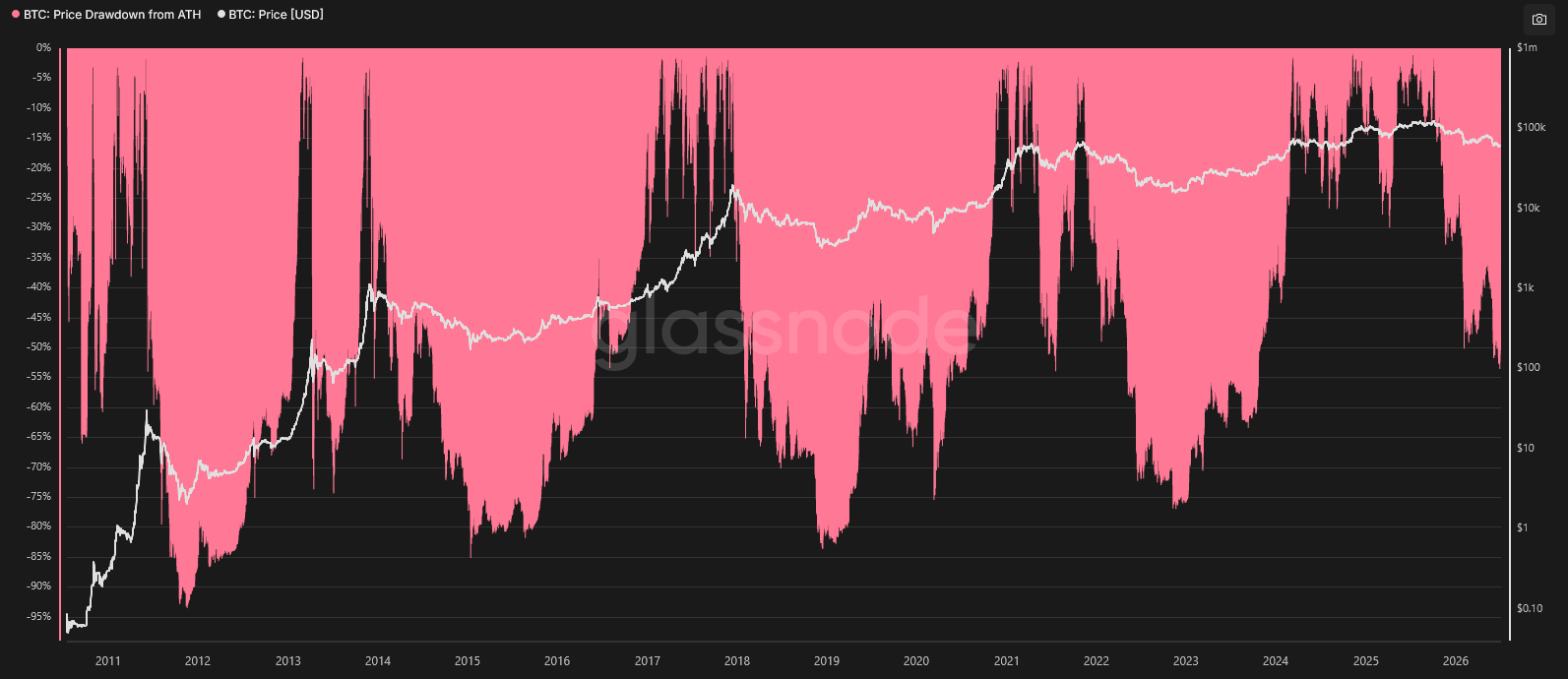
The honest analysts won’t, the smartest macro guys won’t touch the long side until Bitcoin reclaims its 200-day around $70,000, and we’re not going to insult you by pretending we’ve got a crystal ball nobody else has. What we’ll do is tell you plainly what we’re doing and what would change our minds.
We’re accumulating slowly into this weakness, because the market doesn’t owe you a magic number or an October start date, and the people who wait for one have historically bought higher, not lower.
Two things settle the argument from here: reclaim $70,000 with ETF inflows holding and the turn is real, alts are next, and you’ll wish you’d bought this week; lose $57,000 with the forced sellers cracking and it’s Cardone’s world, so you keep your powder and your patience.
The one group we’re confident is wrong is the crowd making Saylor a punching bag and writing crypto’s obituary — not because they’re stupid, but because they’re the same crowd that gave up at the last three bottoms, right on schedule. Being early and a little embarrassed has paid every single time. Being late and chasing has not.
— A.Z., Freedom Finance
*None of this is financial advice. It’s analysis. Do your own research, size your positions to what you can genuinely afford to lose, and don’t make decisions based on price targets from anyone — including us.
P.S. I put together a mini-book on the #1 thing that wrecks altcoin investors — timing.
It’s called “The Altcoin Season Playbook.”
Inside: the 5 repeatable signals that show when altseason is starting, when it’s ending, and when you’re about to become someone else’s exit liquidity.
It’s practical — rotation maps, entry/exit checklists, and the same red-flag indicators that have flashed at the top of every cycle.
Brilliant article