
The Kill Switch for Your Bitcoin Has an Owner Now
And this month, Wall Street starts wiring it into everything you own.

Being a Bitcoin holder in the summer of 2026 is a miserable business.
The price cracked $58,000 on the first of July, its lowest in almost two years, and it has been scraping along in the low sixties ever since, which puts it somewhere around half its October peak of $128,000.
Retail has left the building entirely, with search interest sitting at levels we last saw in the pit of the previous bear market.
June was the worst month the spot ETFs have ever had, roughly four and a half billion dollars walking out the door, and BlackRock’s fund did most of the bleeding.
So you would assume the giants were reaching for the exit alongside everyone else. They are not.
Institutions are still sitting on something like 1.25 million BTC, within a whisker of their all-time high, and the biggest of them all has not so much as flinched. While you were staring at the chart, BlackRock was building something far more valuable than a long position. It was building the plumbing.
I am going to say the thing this industry keeps flinching away from. The institutional takeover everyone spent a decade begging for has finally arrived, and it looks nothing like the validation we were promised. It looks like capture.
The same technology that was supposed to make it impossible for any single party to sit between you and your money is being rebuilt, brick by brick, by the one party best positioned to sit between you and your money. And almost nobody is treating that as a problem, because the man doing it is offering something people want far more than they want sovereignty. He is offering convenience.
Let me show you exactly how far along he is.
The one fund that ate the market
BlackRock did not win the ETF race. It deleted the finish line.
BlackRock’s iShares Bitcoin Trust, ticker IBIT, holds somewhere around 730,000 BTC and roughly forty-five billion dollars in net assets. That is about 61% of the entire spot Bitcoin ETF sector sitting inside a single product, and on any given day IBIT accounts for close to three-quarters of all spot Bitcoin ETF trading volume. Analysts have a polite name for this, “winner-take-most,” which is the sort of phrase you use when you do not want to say monopoly out loud.
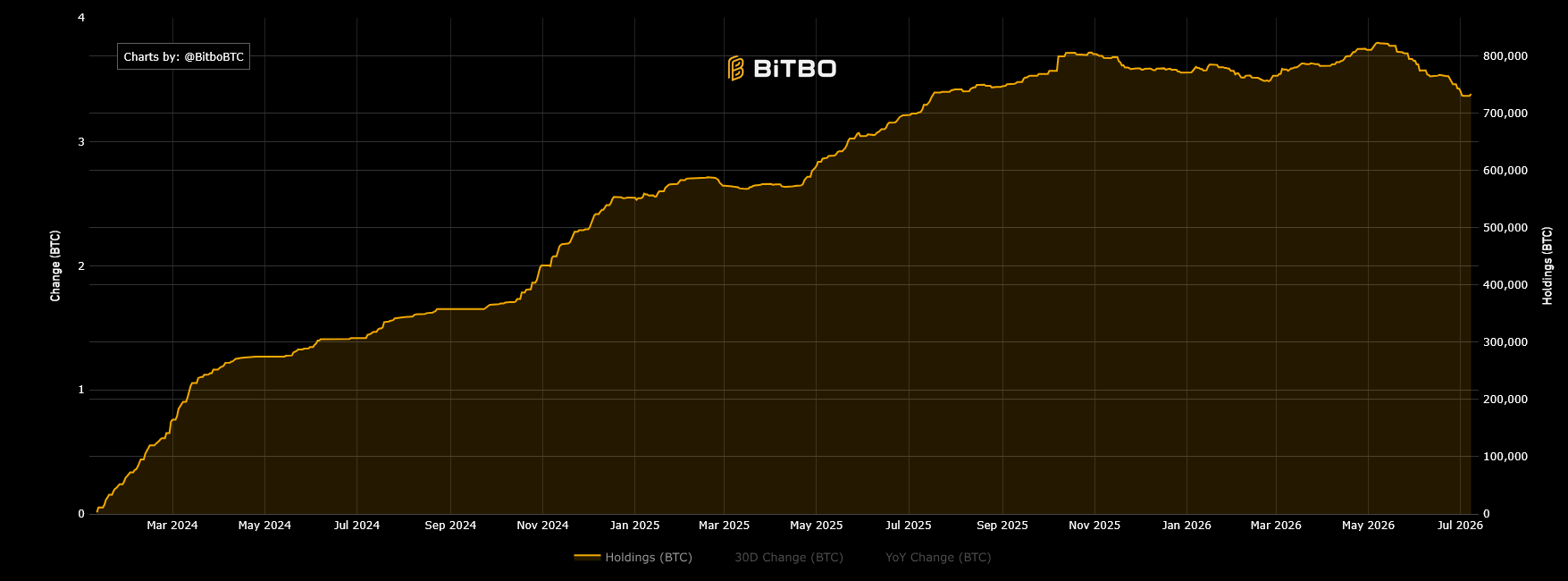
Here is the detail that should bother you more than the size. When those record June outflows hit and everyone screamed that institutions were dumping, BlackRock’s own head of equity ETFs, Jay Jacobs, calmly pointed out that a lot of that money was not leaving at all. It was people selling IBIT and buying BITP, BlackRock’s newer Bitcoin income product, in the same breath. Your capital was not fleeing the fire. It was being upgraded into a more expensive room in the same hotel, and the outflow number made it look like an escape.
That is the whole strategy in one move. Roughly three-quarters of the people who bought IBIT had never owned a single BlackRock fund before it existed. The Bitcoin ETF was the doormat. Once you wipe your feet on it, you are inside the house, and the house sells you the S&P 500 fund, the gold fund, the AI fund, and now a suite of crypto products designed to earn a fee on every possible thing your Bitcoin can do while it sits there.
Every layer of your stack now has a BlackRock fee attached to it
They no longer just hold your coins. They rent out the yield those coins produce.
Start with staking. In March, BlackRock launched a staked Ethereum ETF, ticker ETHB, that takes the ETH it holds on your behalf, stakes it, and then keeps 18% of the rewards for the privilege of having done so. Eighteen percent. Its first cash distribution landed on the ninth of June, a modest $351,669, which matters less as a number and more as a proof of life. The machine is running, inside a regulated wrapper, skimming a fifth of the yield your asset generates. The only reason that number might come down is that Morgan Stanley has filed a competing product proposing to keep a mere 5%, and competition, not conscience, is what tends to move these firms.
Then there is BITP, the iShares Bitcoin Premium Income ETF, launched in late June. This one writes covered calls on 25% to 35% of its IBIT holdings every single month, which in plain English means it sells other people the right to buy Bitcoin’s upside, pockets the premium, targets a 15% to 25% annual yield, and charges you 0.65% on top. Sit with the shape of this for a second. IBIT charges you a fee simply to hold Bitcoin. BITP sells off the upside of that same Bitcoin’s volatility for income. ETHB pockets a cut of Ethereum’s native yield. Three products, three fees, monetizing every layer of the cake, and the cake is your asset. You brought the coins. They built the toll booths.
None of this is illegal, and none of it is even hidden. It is simply the most efficient extraction machine ever bolted onto an asset class that was invented specifically to have no middleman collecting rent. The irony is total, and it is not an accident.
The Treasury fund that can freeze your wallet
BUIDL was never the product. It was the proof of concept.
This is where it stops being about Bitcoin and starts being about everything.
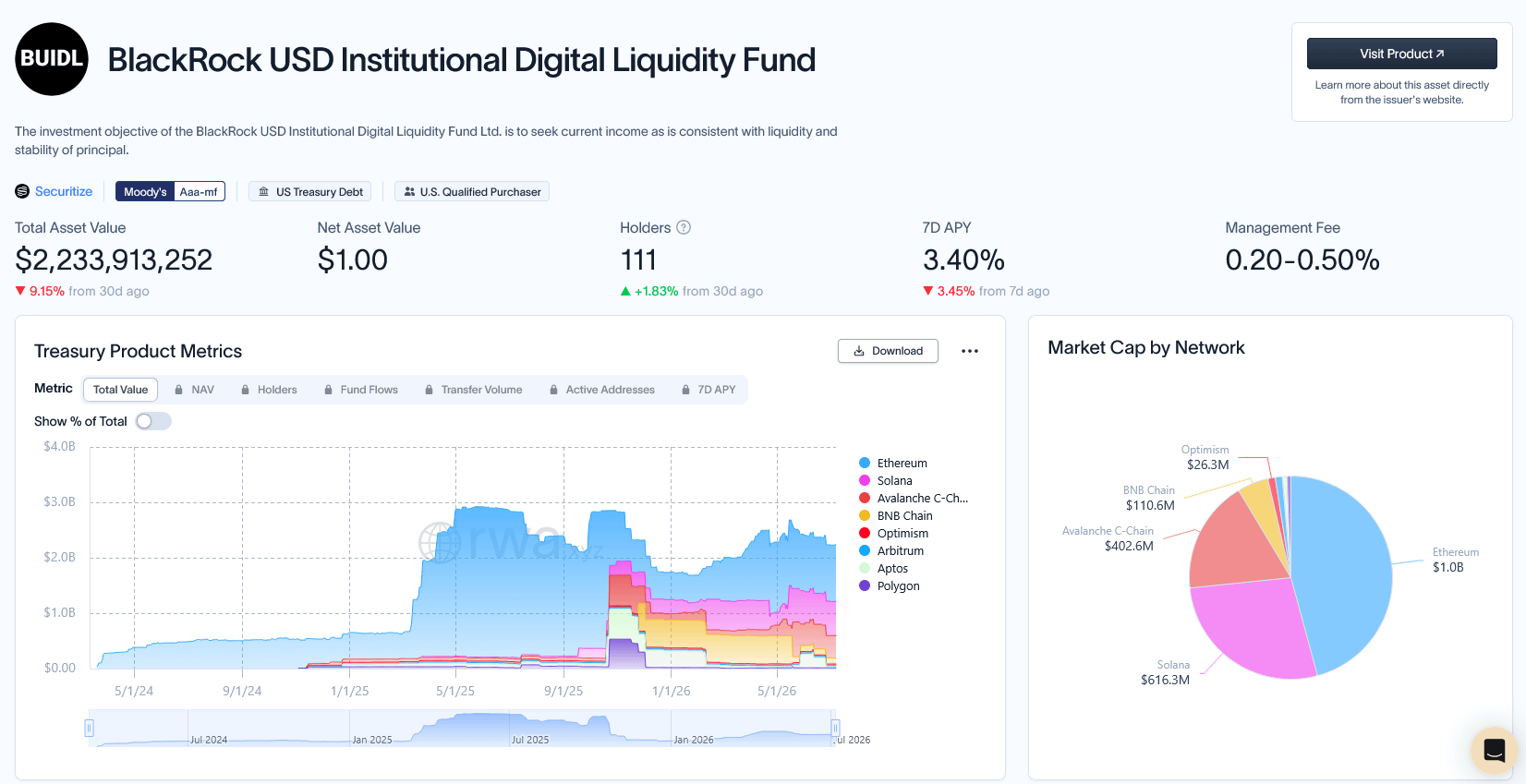
BlackRock runs a tokenized Treasury fund called BUIDL, launched back in 2024, that holds cash and short-term US government debt and keeps a steady dollar value. As of this week it sits at about $2.23 billion, and note that it has actually shrunk nearly 10% over the past month, so this is not some unstoppable rocket. What matters is not the size. What matters is where it lives and what it touches.
BUIDL is live across nine blockchains, including Ethereum, Solana, Polygon, Avalanche, Arbitrum, and Base, and it has been quietly threaded into the guts of decentralized finance as collateral.
It backs Ethena’s dollar product.
It underpins Ondo’s tokenized Treasuries, which show up in more than thirty DeFi protocols.
It is accepted as margin on Binance, on Crypto.com, on Deribit.
Earlier this year BlackRock wired it into on-chain swaps so an institution can trade a BlackRock Treasury token straight for USDC on a decentralized exchange.
Read that back. The stablecoin in your wallet, the lending protocol you thought was permissionless, the margin backing a trade three counterparties removed from you, may already have a BlackRock product sitting underneath it. This is traditional finance climbing directly onto crypto’s rails and turning the whole system into its own private settlement layer.
And here is the part that should end the debate about whether this is decentralization or a costume.
BUIDL is permissioned.
You need to be a qualified purchaser.
You need to pass KYC.
And the issuer can freeze your assets, blacklist your wallet, and restrict your transfers directly through the smart contract.
That entire $2.23 billion is held by exactly 111 holders. One hundred and eleven.
A trustless, censorship-resistant financial system does not have a blacklist function written into its foundational instrument, and it does not concentrate two billion dollars into a hundred wallets that a single company can switch off. What we are looking at is a database with a very expensive marketing budget, and the marketing word is “on-chain.”
What Fink actually told you he is going to take
The number to remember is not $32 billion. It is $114 trillion.
The entire tokenized real-world-asset market, every tokenized Treasury and bond and fund on every public chain, adds up to roughly $32 billion today. Hold that figure. Now here is what BlackRock alone is preparing to bring on-chain.
Larry Fink has been about as explicit as a CEO is allowed to be. In his own words, he expects “every stock, every bond, every fund” to eventually be tokenized, and he has compared this moment to the internet in 1996. He is moving to tokenize BlackRock’s own iShares franchise, and he talks openly about $4.1 trillion in idle liquidity sitting in digital wallets that he intends to “repot” into digital products and keep there. Four trillion dollars, from one firm, against a $32 billion market that exists right now. That is not adoption. That is a flood being aimed at a bucket.
He is not alone, and this is the sentence I need you to actually feel. This month, in July 2026, the DTCC begins live tokenized trades.
The DTCC is the boring, invisible institution that custodies over $114 trillion in securities and sits at the dead center of the American financial system. Last December the SEC handed it a no-action letter clearing a three-year pilot to tokenize real assets, and the timeline is now concrete:
limited production trades starting this month,
full commercial launch in October,
covering Russell 1000 stocks, major ETFs, and US Treasuries.
More than fifty firms are in the working group, including BlackRock, Goldman Sachs, and JPMorgan, the exact same institutions that spent a decade telling you blockchains were a joke for criminals.
One percent of the DTCC’s book moving on-chain is $1.14 trillion in tokenized assets. Crypto’s rails are being rebuilt by Wall Street, for Wall Street, and you were never the customer. You were the beta test.
Now for the trap door underneath it.
In the DTCC’s own design, the blockchain is not the master record. The DTCC keeps the “golden record” on its own centralized ledger, and the tokens riding on public chains are merely mirrored copies of it.
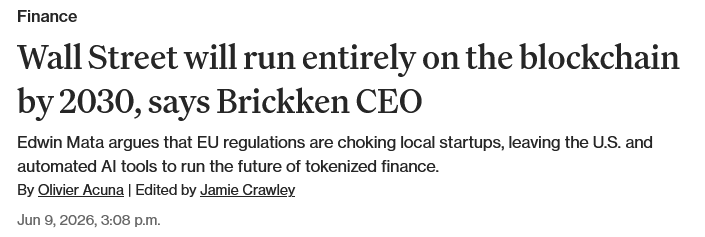
Critics have described this correctly as a faster shared database with override keys, which is the precise opposite of the immutable, trustless system Bitcoin was built to be. Even Vitalik Buterin has flagged the danger of custody concentration, warning about a handful of giants controlling the ETH held inside US ETFs. And the CEO of Brickken, Edwin Mata, said plainly, when he argued that the sheer weight of regulatory compliance builds a moat that protects massive incumbents like BlackRock while locking every smaller, actually-decentralized innovator out of the game. That is the mechanism. The rules do not stop the takeover. The rules are the takeover.
The most telling detail in the whole saga is Nouriel Roubini, an economist who called crypto an outright scam for years, now launching his own blockchain product out of Dubai. When the loudest skeptics start building on the rails they mocked, it is not because they were converted. It is because they finally understood who is going to own the toll roads.
The honest case for letting the fox in
There is one, and pretending otherwise is how you lose the argument.
I am not going to insult you by pretending this is all downside, because the strongest version of the other side is genuinely compelling, and you should hear it before you decide.
Having BlackRock and the DTCC build on blockchain rails is, undeniably, the ultimate stamp of approval. It is very hard to keep calling this technology a casino when the plumbing of global capital markets is being rebuilt on top of it. The efficiency argument is also real. Tokenization promises near-instant settlement instead of the day-plus lag we live with now, markets that run around the clock, and fractional ownership of assets that ordinary people were locked out of for a century.
With the ten-year Treasury yielding around 4.5%, tokenized Treasury funds let stablecoin holders earn a near-risk-free yield on-chain that simply did not exist a few years ago. And the money is not theoretical. BlackRock’s digital asset products pulled in $42 million of revenue in a single quarter, and BUIDL has paid out over $100 million in dividends since it launched. BlackRock’s own COO, Rob Goldstein, frames all of this as complementary, a bridge between the old system and the new rather than a hostile takeover.
He might even believe it. It does not matter whether he does. A bridge built and owned and toll-gated by one side is not a neutral bridge, and convenience delivered by a party that also holds the override keys is not a gift. It is a lease. The efficiency is real. The yield is real. The catch is that you access all of it by handing the master copy of your ownership to the exact kind of gatekeeper the entire experiment was designed to abolish.
What you are actually trading away
Crypto was invented for one narrow, radical reason: so that nobody, no bank, no government, no asset manager, could freeze your money or wedge themselves between you and the thing you own.
Every other feature was decoration on top of that single load-bearing idea. The version Wall Street is now assembling keeps every piece of the decoration and guts the load-bearing part. You get the app, the yield, the 24/7 markets, the slick tokenized wrapper. What you give up is the only thing that ever made it different from what came before.
The trade being offered is convenience in exchange for control, and the brutal truth is that most people will take that trade without a second’s hesitation, because most people love the convenience and have never once needed the control.
They will keep loving it right up until the morning they discover the wallet does not answer to them anymore. By then the golden record will be sitting on a ledger in lower Manhattan, the override keys will belong to a firm managing more money than most nations produce, and the fund that started as a friendly little Bitcoin ETF will have become the front door to a system you no longer own any part of.
The fox is not asking to be let into the henhouse. He already redrew the property lines, and this month he starts collecting rent. The only open question left is whether anyone in this space still remembers why we bothered building a lock he was not supposed to have the key to.
— A.Z., Freedom Finance
*None of this is financial advice. It’s analysis. Do your own research, size your positions to what you can genuinely afford to lose, and don’t make decisions based on price targets from anyone — including us.
P.S. I put together a mini-book on the #1 thing that wrecks altcoin investors — timing.
It’s called “The Altcoin Season Playbook.”
Inside: the 5 repeatable signals that show when altseason is starting, when it’s ending, and when you’re about to become someone else’s exit liquidity.
It’s practical — rotation maps, entry/exit checklists, and the same red-flag indicators that have flashed at the top of every cycle.
As ever brilliant article